
Product managers
When you need to understand the users and find a solution that does not violate the product's constraints.
Scenario · Golden Trio
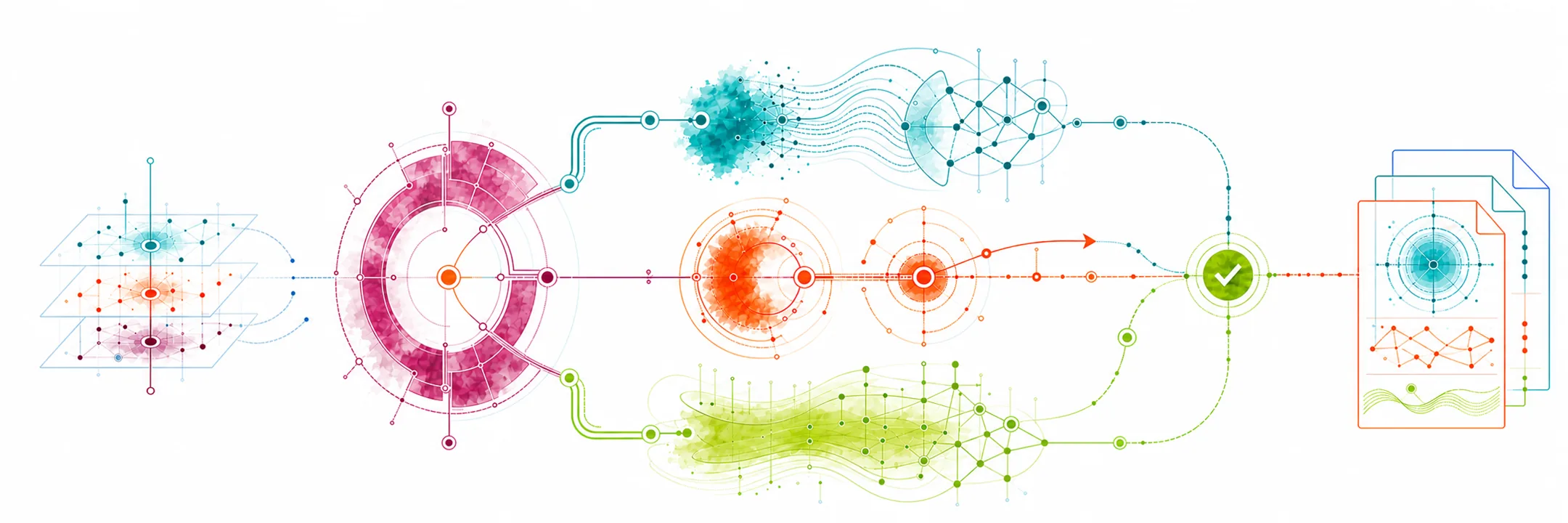
Three AI agents work sequentially: CustDev researches the audience, Super Oracle finds the solution, Muse reviews the result. The human controls every stage.
The agents support local and cloud models; the selected configuration and data flows are agreed before launch.
A demonstration using synthetic materials is available without processing customer data. Full deployment follows an approved estimate.
Four roles for whom the scenario saves time and reduces the risk of subjective decisions.
When you need to understand the users and find a solution that does not violate the product's constraints.
When the contradiction between "the user wants" and "we can build" blocks progress.
When you need to collect observations, surface contradictions and check the conclusions for honesty.
When you need to test hypotheses before launching expensive development.
Each agent performs its own task and returns its own result. CustDev does not invent solutions. Super Oracle does not check clarity. Muse does not collect observations.
Context handoff
The next agent receives the approved result: conclusions, evidence, limitations and the human's remarks. The original materials do not become available automatically.
Automation does not skip over an ambiguous or sensitive choice.
After the stage: Research
Is the sample sufficient and are the conclusions correctly tied to the materials?
The human checks the conclusions against the original materials: whether the conclusions are too strong for the limited data, whether every link to a source is justified.
After the stage: Invention
Is this the problem the team actually intends to solve?
The team confirms that the chosen contradiction is the root cause, not a symptom. Without this step the solutions will treat the consequence.
After the stage: Invention
Which solutions are acceptable in terms of risk, deadlines and values?
Not all directions are equally safe. The human filters out the options that violate the constraints of the product or the team.
After the stage: Audit
Which findings block the release and which require a test?
Muse sorts the findings by severity: blocking, requiring verification and cosmetic. The team decides what to fix before the release.
The team sees not only the final recommendation, but also the path from the original observation.
The scenario does not make product or investment decisions, does not promise market success, does not replace legal or industry expertise and does not make the conclusions more reliable than the source data.
A typical scenario: from uploading interviews to a verified document with recommendations.
You upload 15 interviews with users of the product.
CustDev identifies 8 recurring needs and records the open questions.
Super Oracle formulates the main contradiction "Simplicity vs security" and suggests 3 solution options.
Muse checks the conclusions and finds 3 hidden assumptions in the wording.
Direct answers for quick reading.
Materials for the research: interviews, notes, documents. A description of the task and the completion criteria. Access to data within the approved scope.
Timing depends on the material volume, selected configuration, and human review. An estimate is agreed before launch, and every stage is recorded in the log.
Yes, each agent can work independently. The full sequence is useful when the task requires all three stages: research → contradiction resolution → independent audit.
The human returns the artifact for rework with new conditions. Any stage can be repeated. The decision to approve or reject always stays with the human.
No. You upload the materials and describe the task. The agents perform the analysis, you verify the result.
First step
Pick one of the twelve agents and subagents, or fill in the questionnaire for custom development.